
Product data is the foundation
Which product data do you really trust? Thedata in PIM? In ERP? In Excel spreadsheets? In various documents? Or the knowledge of individual employees?
In many packaging companies, product data is scattered across PIM, ERP, Excel, or the minds of employees—often maintained in multiple places and riddled with contradictions. That’s no longer enough today: AI, the PPWR, digital product passports, and sustainability requirements all demand reliable data.
A simple principle applies here: Any AI is only as good as the data it works with. If product data is incomplete, contradictory, or outdated, these problems aren’t solved—instead, they become apparent more quickly and directly impact processes, decisions, and results.
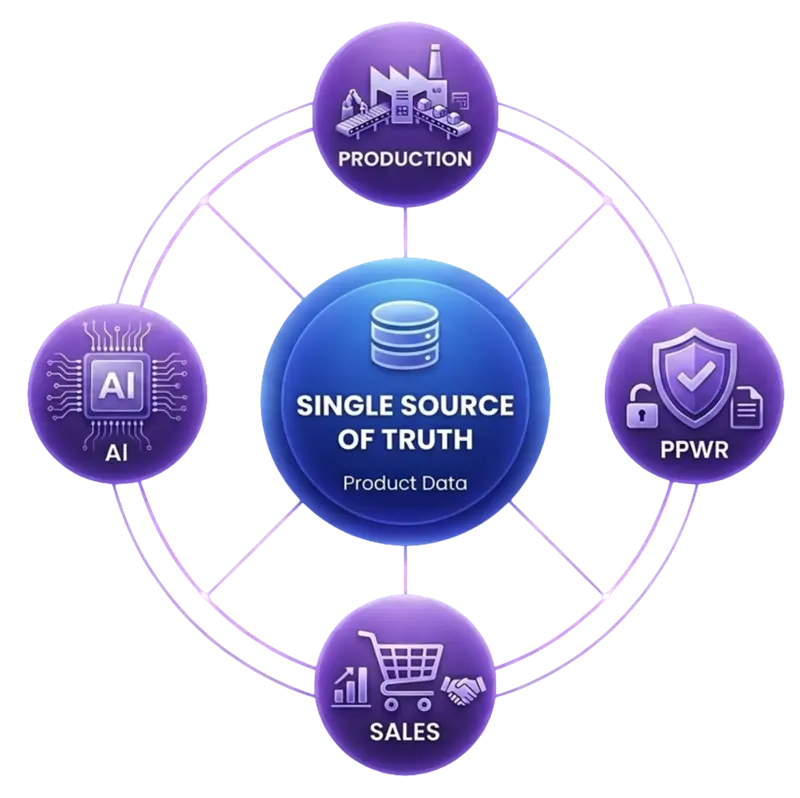
The path to a future-proof product data strategy therefore does not begin with new technology, but with a centralized, trustworthy database—a single source of truth with clear responsibilities and high data quality.
Time for a Master Data System
Many companies are investing in AI—but they’re still working with product data that has accumulated over the years.
Product information is scattered across PIM systems, ERP systems, Excel spreadsheets, and various documents. Different departments maintain the same data multiple times, approvals aren’t always clear, and there’s often no reliable source of data. This wastes time, hinders collaboration, and makes every new requirement more time-consuming.
With PPWR, digital product passports, and AI, the pressure to act is increasing even further. That’s because these developments require product data to be complete, consistent, and available at all times.
A master data system and a single source of truth lay the foundation for this. AI can help automatically verify data quality, identify inconsistencies, and continuously improve product information.

B2B: When AI Becomes a Buyer
Technical buyers are increasingly using AI-powered assistants, smart search functions, and automated procurement processes to research and compare products. As a result, AI is increasingly becoming the first point of contact in B2B procurement.
In the future, the key question will no longer be:
| “Will my product be found?”
but rather:
| “Can AI understand, categorize, and recommend my product?”
The answer depends not on the AI, but on your product data. Companies that centrally manage and continuously optimize their product data in a master data system lay the foundation for greater visibility in digital sales channels.

Product Data Becomes a Sales Channel
The more complete, up-to-date, and consistent product information is, the better it supports sales, marketing, compliance, and digital business processes. Product data thus becomes an active component of customer communication and a decisive competitive advantage.
In the past
Product data as internal master data
- • Management
- • Documentation
- • Internal processes
- • Manual maintenance
- • Individual systems
Today
Product Data as a Sales Channel
- • Selling point
- • Basis for consultation
- • Proof of compliance
- • Marketing content
- • AI knowledge base
Where Structured Product Data Makes a Difference
Our Approach:
From Data Analysis to Innovation
Many companies face a variety of challenges. Some struggle with unclear data structures, others with regulatory requirements or their first AI initiatives.
That’s why we follow a simple principle: Understand, Structure, and Activate. Each workshop meets you where you are in your data management journey and works with you to take the next necessary steps.


PETnology 2026: Slides to Take Home
The slides from the presentation “You’re Optimizing Your Production—But Not Your Data” from PETnology 2026 are available for download as a PDF here.

![[Translate to English:]](/fileadmin/_processed_/7/d/csm_data-management_fff01b0e0c.jpg "[Translate to English:]")
![[Translate to English:]](/fileadmin/_processed_/8/3/csm_pet-unuebersichtlich_342a5d0c9b.jpg "[Translate to English:]")
![[Translate to English:]](/fileadmin/_processed_/5/4/csm_bottle-production_33fd411d7f.jpg "[Translate to English:]")