For us, accessibility means more than just technical implementation - it is an expression of our attitude. With "No One Left Behind", we show what drives us: We want to create digital experiences that don't exclude anyone.
We think about inclusion right from the start - in design, content and code. This results in solutions that not only comply with legal requirements, but also enable genuine participation, accessibility and equality.


Not just a duty: accessibility
In the digital age, accessibility is not a "nice to have", but an expression of real responsibility - and a clear success factor for digital products. With our Accessibility Quick Check, you receive a well-founded initial assessment of the status of your digital offerings - quickly, comprehensibly and individually. Together, we set an example for digital participation. Because our claim is clear: #NoOneLeftBehind
Legal basis
The Barrierefreiheitsstärkungsgesetz (BGG) and the EU Directive 2019/882 (European Accessibility Act) oblige companies to make their digital offerings (websites, apps, online stores) accessible from June 28, 2025. The offerings must at least comply with the Web Content Accessibility Guidelines (WCAG) 2.1 - Level AA. This includes, among other things:
- Content: Alternative texts for images/videos, subtitles.
- Design: Sufficient contrast between text and background.
- Operation: Mouse-free navigation (e.g. via keyboard).
Further obligations and consequences:
- Companies must provide an accessibility statement and a contact option for reporting barriers.
- Violations can result in severe penalties up to and including the discontinuation of the digital offering.
(Implementation is currently based on the WCAG 2.1 guidelines, with WCAG 2.2 already available as an option )
Benefits for companies and users
Accessibility is more than a legal obligation - it is a strategic success factor. Accessible design opens up access to new target groups: People with disabilities and older users form a constantly growing user group that is increasingly dependent on digital offerings. Removing digital barriers not only increases reach, but also user satisfaction.
Accessibility also has many advantages for users without disabilities. Clear structures, easy-to-read texts and intuitive navigation improve usability and the user experience for everyone. This strengthens customer loyalty, reduces bounce rates and has a positive effect on search engine optimization (SEO), as accessible pages are generally easier to index, have a clean technical structure and are optimally prepared for machine readability by AI bots.
How do you implement accessibility?
Implementing digital accessibility requires technical expertise and well thought-out planning. +Pluswerk offers comprehensive consulting and testing services to test your digital offerings for accessibility and adapt them to legal requirements. Our measures include
- Analysis and audit: we check your existing website or application for accessibility and identify potential barriers. Ask now for our accessibility quick check with no obligation.
- Individual solutions: Based on the analysis, we develop customized solutions to remove barriers and ensure accessibility for all users.
- Training and advice: Our experts train your teams in the principles of accessibility and support you in the continuous optimization of your digital presence.
By planning and implementing measures at an early stage, you can not only meet the requirements of the BFSG, but also improve the user experience for all visitors to your website.
The +Pluswerk Quick Check
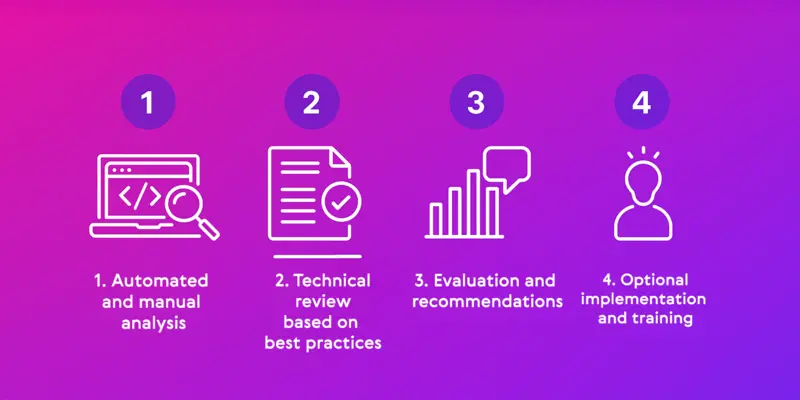
With the help of our systematic 4-step process, we precisely analyze digital barriers, derive specific recommendations for action and provide support with technical implementation. We combine automated tools with in-depth manual expertise in accordance with WCAG and BFSG.


![[Translate to English:]](/fileadmin/_processed_/5/9/csm_konzeption_1db8152b65.jpeg "[Translate to English:]")
![[Translate to English:]](/fileadmin/_processed_/3/c/csm_cloud-hosting-3_83be46f2ff.jpg "[Translate to English:]")